

"We were killing ourselves with logistics"
How Kansas Leadership Center’s debates are unlocking the power of community disagreement

In late November of 2025, the Wichita City Council prepared a special ballot measure to see if the city’s voters would approve a 1% sales tax increase.
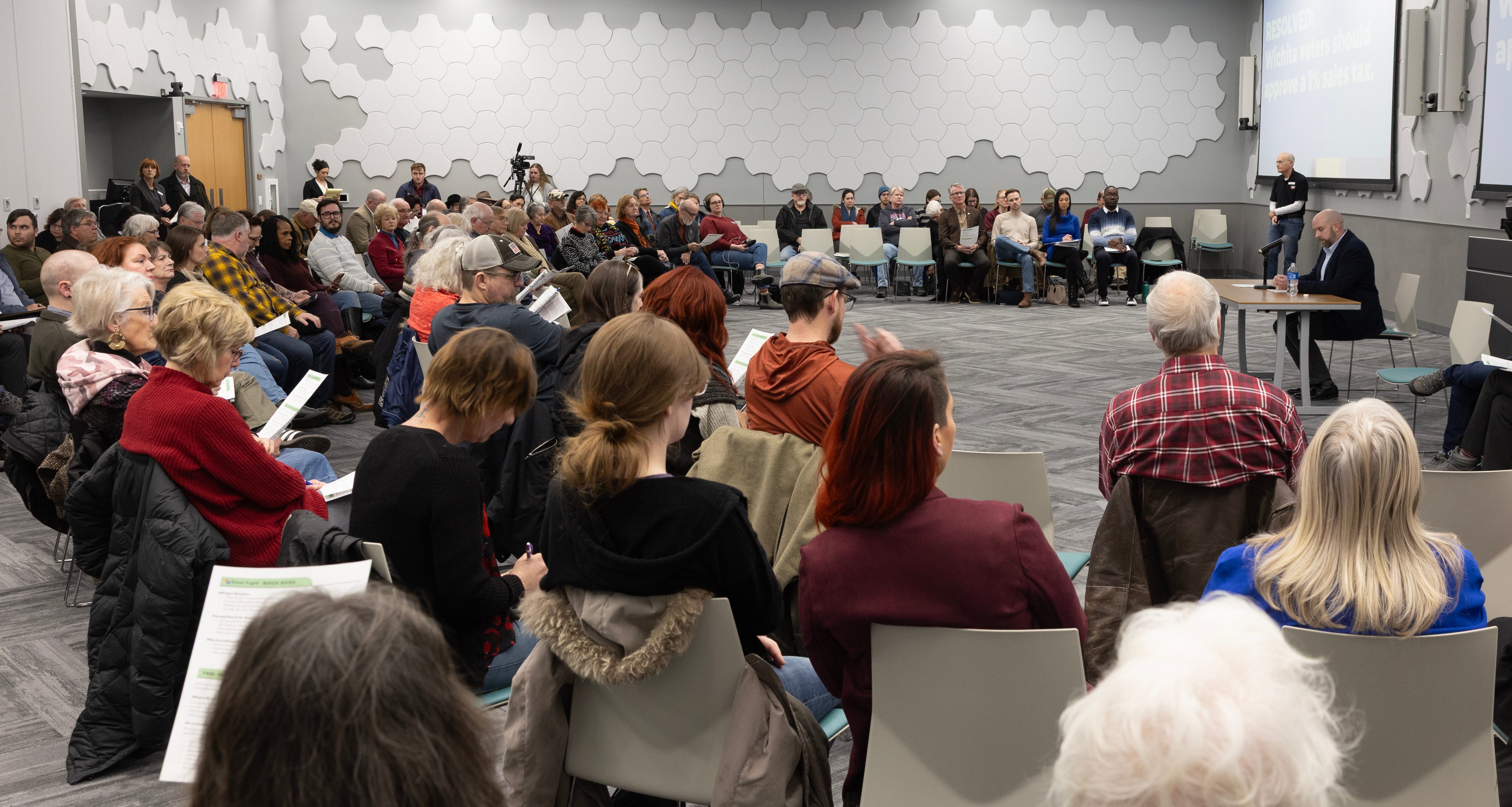
Two months later, leaders from the Kansas Leadership Center (KLC) hosted a Braver Angels Debate on Resolved: Wichita voters should approve a 1% sales tax.
“This sales tax came up without a lot of information,” Dani Gains, Journal Manager at KLC, told me. “Everyone initially was freaking out.” Before voters rejected the tax hike on March 3, Dani told me that the tension in the Wichita community was palpable. “We are definitely a city divided on this issue right now.”
Chris Green, Civic Information Officer and Executive Editor of the KLC Journal, felt it, too. This debate was not just timely for the community, it was pressing; urgent. “We’re living the debate,” he told me.
When I asked Dani how the debate came about, she told me that KLC was approached in early January about the idea. “Another organization reached out and said, ‘Hey, we’d like to put on a debate on this Wichita sales tax issue. Is that something you’d like to partner in?’” Three weeks later, on January 26, the debate took place.
Given the tension in Wichita, KLC organizers were wary. “We were thinking, ‘Shoot, this might be a horrific discussion. This may go so wrong.’” Jason Bosch, Director of Curriculum Innovation at KLC, chaired the debate. “I went into that debate with some uncertainty, and honestly some hesitation, about whether the community would lean into the BA process given how hot this issue was.” Many attendees treated the debate like a city council meeting rather than a structured debate. Some didn’t want to register; others wanted to be able to stand around the perimeter of the room rather than in the Braver Angels Debate semicircle arrangement. Dani, who staffed the registration table at the event, told me that “a lot of people were just walking past me. A lot of people were ignoring me.”
“And then it happened to be a really wonderful conversation,” Dani recounted. Over 150 people joined the debate. Attendees told Dani that the debate “raised the bar for civil discourse.” Local news outlets (including The Journal, KLC’s own publication) published reviews of the debate after it took place. After the ballot measure failed, city officials approached Kaye Monk-Morgan, KLC’s CEO, to ask her how KLC pulled off the event.
How did they do it? And, more importantly, why? Why was an internationally recognized leadership organization like KLC devoting its staff’s time and energy to hosting Braver Angels Debates? It all started a year ago.
KLC’s introduction to debates
In late spring of 2025, Manu Meel of BridgeUSA spoke at KLC, and he mentioned successful Braver Angels Debates on controversial topics like Israel and Palestine. Curious whether KLC might have some use for the format, Chris reached out to the Debate Team.
When I met with Chris and Dani last June, I was intimidated. They were curious about the Braver Angels Debate format and how it might fit into their mission, but I couldn’t help wondering to myself: Chris and Dani are professional staff at a high-performing leadership development organization. What can we offer them that they don’t already know?
My insecurities notwithstanding, the KLC team decided to give debates a try. As a member of Braver Network, they have access to up to 100 complimentary memberships for their leaders, and they quickly put them to use. Chris and Jason enrolled in Debate Chair Training, and Dani signed up to become a Debate Organizer.
Many who complete our Debate Organizer Training have some past experience organizing events, but Dani has a great deal more than any organizer trainee I’ve worked with. So I asked her: What, if anything, did our training offer to her that she didn’t already have? “The training really helped with an overview of what I need to be doing to organize these debates,” she told me. “The resource folder was most helpful. Being able to go back and check on different things like crafting a resolution is incredibly helpful, because I don’t think we’ve mastered that quite yet.”
The final step to earning this qualification is hosting a Braver Angels Debate. The first debate that Dani organized was for KLC staff only. Chris wanted to test the format in a controlled environment to see if others shared his instinct that it could help their team live its values. To draw attention to the format, the team debated a lighthearted resolution about which side of Wichita is better: East or West.
Despite the playful topic, participants spoke passionately. “They were talking about which side of town they cared about, but the experience you had was that people really cared about their community,” Chris remembered. “This thing that was binding us together was that we all cared about Wichita.”
The East-West KLC debate happened in October of 2025. Convinced of the format’s power, Chris, Dani, and Jason then went on a tear of debate organization and planning. With each successive debate, they took on new challenges.
Following the internal debate, the team wanted to do an event in their building—where their leaders felt comfortable—on a difficult topic. “We had just done the birthright citizenship article in The Journal,” Chris told me, and Braver Angels had hosted a national debate on the topic earlier that year. So, in November, the team hosted a debate at KLC on Resolved: End birthright citizenship.
“We wanted to keep pushing ourselves,” Chris told me while recounting his and Dani’s early discussions about where to go for their second public debate. Dani had been in intermittent talks with several stakeholders in Lawrence, Kansas, about the possibility of a conversation examining housing issues in that community. The event had been in the works for a year, but progress on the format for the conversation was slow.
“And then we learned about Braver Angels, and we started training on it, and we thought this method might work really well,” Dani told me. “And I’m like, ‘Alright, let’s see if they’ll buy in,’” Chris told me. Then, he explained how his team pitched their stakeholders in Lawrence.
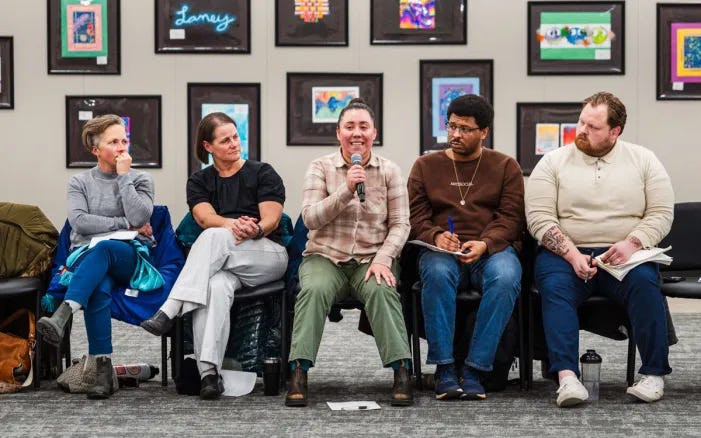
In their meeting with Lawrence community leaders, the KLC team first asked what concerns the team wanted to address. Division over the issue of housing was leading to conflict, and community members didn’t have a place where they could express their views and feel heard. “Then we pitched [the debate] back to them as something that we think could address most of those concerns,” Chris said matter-of-factly.
It was KLC’s debate in Lawrence that began to attract serious attention. The debate, which eventually became a partnership between KLC and the City of Lawrence, saw 57 residents come together (in December, no less!) to debate Resolved: Lawrence is doing enough to be a place where there is housing for all. Multiple local outlets published stories about the event, and the KLC team received overwhelmingly positive feedback.


It was on the heels of their success in Lawrence that the KLC team was contacted about the possibility of a debate on the 1% sales tax in Wichita.
What’s the matter with Kansas?
When I saw the news coverage of KLC’s debates in Lawrence and Wichita, I began to think there was something truly special afoot inside the Kansas Leadership Center. And when my team and I put together that KLC had prepared and hosted four Braver Angels Debates in just as many months, I was convinced I needed to investigate. Why had KLC, an organization with its own priorities and goals, hosted as many debates in four months as our most engaged local alliances do in a whole year? What are Braver Angels Debates unlocking for KLC? And can I find ways to replicate this success elsewhere?
After some deeper reading about the organization’s mission and leadership framework, I conducted a series of conversations with KLC leaders Chris, Dani, Kaye, and Jason. I asked each of them what they could do with our debate format that they couldn’t do before.
Their answers showed me that our debates had unlocked at least three things: robust community engagement, a trustworthy repeatable process, and an opportunity for leaders to practice leadership skills.
Tapping into the wider community
“We teach leadership, and we are bar none internationally,” Kaye told me in our conversation. “Top five in the world.” Despite doing work with leaders from 77 countries, KLC is always trying to find new ways for its mission to reach beyond the KLC offices in Wichita. “KLC has, in our history, served more people that have a doctorate degree than only a high school diploma,” she told me.
The Braver Angels Debate, however, was a room where Kaye could “see a woman who is currently unhomed stand up, say her piece, and then give a report at the end when talking to a reporter that says, ‘I got to say what I wanted to say. I’m a part of this community, and I feel seen in this community.’” To Kaye, the power of the debate program was its ability to bring people of all backgrounds together on the same playing field. “There aren’t a lot of places in our community where that type of interaction happens.”
In other words, Braver Angels Debates have unlocked community engagement for KLC. In her role, Dani has planned a number of events around Kansas on topics like housing and homelessness. When trying to prepare events that tackled a specific community’s issues and needs, Dani often struggled to assemble the right mix of voices for a panel or series of talks. “You’re not going to be an expert on it,” she said. “You don’t really even know what’s going on beyond what your partners are telling you.”
Once the team began experimenting with the debate format, however, they watched as debates attracted the mix of voices that they’d been looking for all along. “Your group picks itself and comes in,” Chris offered. “And I didn’t know if that would actually work, but my experience with the first three that we’ve done is: it’s worked pretty darn well.”
A good process
“Much of the work we do,” Jason (who has up to now chaired every KLC debate) told me, “is grounded in David Chrislip’s collaborative premise.” That premise holds that “If you bring the right people together in constructive ways with good information, they will create authentic visions and strategies to address the shared concerns of their organization or community.” Or, as Kaye put it to me, KLC thinks that the right people, “with good training, good information, and a good process,” can make progress on a complex community challenge.
“The third leg of that is a good process,” she noted, “and Braver Angels, for us, is a really good process.”
KLC had been trying to come up with ways to effectively facilitate events that landed well with different communities around Kansas. “Panels…oh my gosh, we’ve done so many panels,” Dani told me. Chris, speaking of the amount of trouble to which Dani had gone to piece together events in the past, put it this way: “We were killing ourselves with logistics.” His team had hosted some great conversations about issues affecting Kansas communities, but all of their time was spent on scheduling and event design.
The Braver Angels Debate format compressed that planning process and made their lives simpler. The trick, Chris discovered, was framing the debate the right way. “If you get that resolution right, you create this divergence that brings people in.”
Our debate format was the wheel that KLC didn’t have to reinvent. The way Chris sees it, “The wheel’s invented. We just roll the wheel in different places.”
Practicing core competencies
Not unlike Braver Angels workshops or events, KLC’s leadership development programs are transformative for participants. For Kaye, however, “If nothing changes as a result of what we’ve done, then we failed.”
When I asked her how Braver Angels Debates supported KLC’s strategic goals, Kaye spoke at length about how KLC is always seeking ways to help their community servants practice the theories that they learn at KLC. “Braver Angels has given us a way to say, ‘We taught you how to do this. Now let’s do it.’”
Chris gave me an example to zero in on Kaye’s point. He told me that one of KLC’s core competencies, “Manage Self” involves the capacity to choose between competing values. “When you have a really important leadership decision to make, you’re seeing values clash together, and you have to choose to move forward.”
For Chris, the debate format laid these value conflicts out for the trained eye to see, and it was easy for him to imagine how a leader who had undergone training with KLC could practice this and other core leadership competencies.
In my conversation with her, Kaye listed several other competencies. Among them were “Diagnose the Situation,” “Manage Yourself,” and “Intervene Skillfully.” She walked me through the ways that Braver Angels Debates tested these competencies.
Drawing on the example of the 1% sales tax issue, Kaye told me about the way a KLC leader might practice diagnosing a situation. In their debate, there were people who were in favor of the sales tax and people who were opposed to it. “That’s not very sophisticated analysis,” she noted. Each position contained a multitude of factions, each of which would need to be accommodated to make progress on the issue.
“Within the ‘no’ group, there are people who say no because they don’t trust local government. There are people who say no because they don’t trust the mayor in particular. There are people who say no because they don’t like the five projects that are being funded.”
Because the binary of the debate format requires attendees to explain why they are for or against a resolution, the program sets up Kaye to turn to her trained leaders and say, “you ought to know how to show up in a space and have a deep conversation. What are the factions that are alive in the room?”
Overcoming reservations
Increasingly attuned to the added value of the debate format for KLC, I began to wonder whether the team had to overcome any initial reservations about trying the format. Sure enough, KLC leaders noted that there were some early discomforts.
One of the recurring themes of my conversations with the team was the idea of experimentation. The Braver Angels Debate Team is not pedantic or rigid about our format, but we do have some lines (for example, Debate Chairs are not to give speeches in a Braver Angels Debate). Accordingly, I wouldn’t characterize our approach to supporting local debates as one that is particularly notable for its flexibility.
But to my surprise, KLC leaders viewed things differently.
In conversations about the debate planning process, Chris, Dani, and I would often open up discussions about the integrity of the format and different innovations. For example, ahead of their January debate on the 1% sales tax, Chris wanted to know what I thought about framing the Braver Angels Way as an oath for attendees to take before beginning the debate. Having never been asked this question before, the three of us thought through the implications of such a change in real time. To Chris, these conversations were evidence of an openness to experimentation.
The Debate Team will “emphasize the principles or the key things to do,” Chris said, “but you’re really flexible about trying new things, or thinking about new things, and I appreciate this balance of holding to principle and being flexible.”
A second point of unease was rolling out a process that wasn’t their own. Knowing that KLC is an innovator, I asked leaders whether there was discomfort in trying a format that they didn’t invent.
“Because KLC has such ownership over what it does in Kansas, it felt a little uncomfortable to say, ‘We’re going to take this national thing and use it here,’” Chris explained. That is why he wanted his team, which handles only about 10-15% of KLC’s overall work, to show the rest of the organization their experiment. “I wanted buy-in from the whole staff.”
What’s next?
Chris and his team have the staff buy-in they sought at the outset , and they have plans to continue hosting debates with their characteristic versatility.
In each of my interviews, I asked about the KLC team’s future goals for Braver Angels collaboration. “It feels like the world is our oyster with this method,” Dani told me. “I think one of my big aspirations is getting more KLC staff involved.”
Jason agreed. “I am curious to continue experimenting with the BA format, particularly around timely local issues.”
What’s Chris’ Braver Angels goal for the year? “It’s pretty simple,” Chris said. “It’s to do three more debates and have them be pretty high profile, and to get at least one more moderator trained.” Then, he intends to look back at the end of 2026 and set even bigger goals.
Kaye would like to explore whether the debate format can facilitate improved engagement between elected officials and citizens. “My meeting after you is with the office of one of our state senators,” she told me during our interview. “Hosting town hall meetings has become really difficult for our elected officials.”
The KLC team all shared a desire to make ownership of the debate format accessible to more people in the KLC network. “I feel like just about anybody at KLC, with a little bit of training, could do the Braver Angels model,” Chris said (and we agree).
The team is well on their way to meeting their goal of hosting one debate each quarter. The team has been asked to lead a debate for a news industry audience this June at the Kansas Press Association Convention and Awards Ceremony. Chris will be chairing his first-ever debate on Resolved: Journalists need a digital personality to stay relevant.
Is KLC special?
One question animating my conversations with KLC leaders was whether this uniquely successful partnership could be made less unique. In other words, I wanted to know whether our programs could do for other organizations what Braver Angels Debates were able to do for KLC.
In a few ways, of course, Kansas Leadership Center is one of a kind. It is a well-staffed organization with a distinctive mission and a team of leaders uniquely devoted to that mission. Its goal of equipping and inspiring people to do difficult things together for the common good is in deep harmony with Braver Angels’ honored norm of Courageous Citizenship.
It is also deeply embedded in Kansas. Community members in every corner of the state have experienced its trainings, and through the Wichita Journalism Collaborative, KLC is embedded within a network of local media outlets and newsrooms. Over time, its staff have amassed a number of insider connections in Topeka.
When I initially spoke with Chris, Dani, Kaye, and Jason, I began to fear that these distinctive assets were the keys to explaining the successful overlap between the Debate Team and KLC. Over time, however, I began to see that there were more widely applicable insights to be gleaned from their successes.
KLC is surely not the only organization who has sought an event format that can engage a community on a local issue without drowning the organizers in the curation of a conversation. It’s not the only organization who is looking for new ways to help its network practice their skills of relationship building and problem solving. And it’s not the only organization who has struggled to reach a wide cross-section of a community.
Even KLC’s misgivings about our format are likely to be shared by other potential partners. They are not the first organization to wonder how they can have local ownership of a program coming out of a national nonprofit. Other organizations will feel the inclination to adapt our formats to their specific needs.
For us at Braver Angels, partnerships can unlock new appreciation for both the value added by our programs and the hurdles to be cleared by organizations considering adopting them.
Are you reading this as an organization that’s killing itself with logistics? Are you struggling to engage your community? Are you in need of a trusted, plug-and-play program format?
The wheel has already been invented. It’s yours to roll wherever you like. debates@braverangels.org.
KLC team and BA partnership: what an inspiration to others!